
Infant Vitamin D: 1000 IU weekly is better than 240 IU daily (better compliance)
Weekly vitamin D supplementation: A practical strategy for preventing vitamin D insufficiency in early infancy - Editorial
Pediatrics & Neonatology, https://doi.org/10.1016Tj.pedneo.2026.01.001
Vitamin D insufficiency in infants remains a significant global public health concern, with consequences including nutritional rickets and impaired bone mineralization [1,2]. Guidelines from the American Academy of Pediatrics and a global consensus group recommend daily supplementation of 400 IU from birth to 12 months for all infants [1,3]. However, parental adherence to this daily regimen is suboptimal in many countries, limiting the effectiveness of the intervention.In a two-center retrospective cohort study, Hara-Isono et al. investigated whether weekly vitamin D supplementation (1000 IU/week), administered together with vitamin K prophylaxis, can effectively prevent vitamin D insufficiency in 3-month-old Japanese infants [4]. They analyzed serum 25-hydroxyvitamin D [25(OH)D] levels in 555 infants, which were classified into three groups:
- control (weekly vitamin K only, n = 414),
- weekly vitamin D supplementation (vitamin D 1000 IU/week + weekly vitamin K, n = 55), and
- daily vitamin D supplementation (240 IU/day + weekly vitamin K, n = 86) [4].
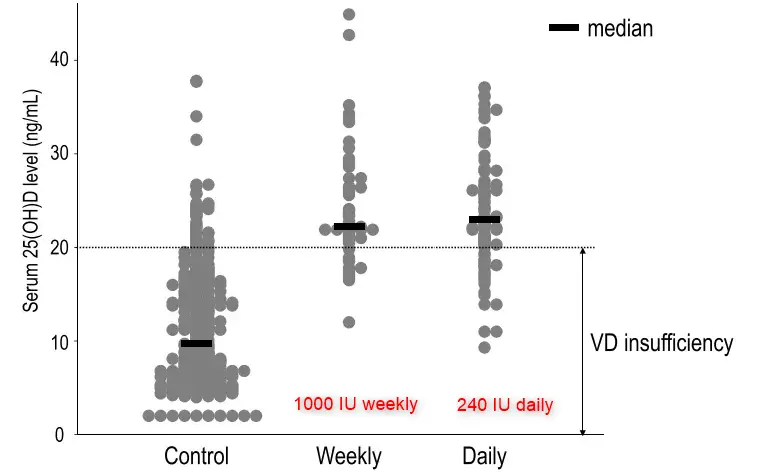
The median serum 25(OH)D levels in both vitamin D groups were significantly higher than those in the control group (control 9.7 ng/mL vs weekly 22.2 ng/mL vs daily 23.0 ng/mL, p < 0.001) [4].
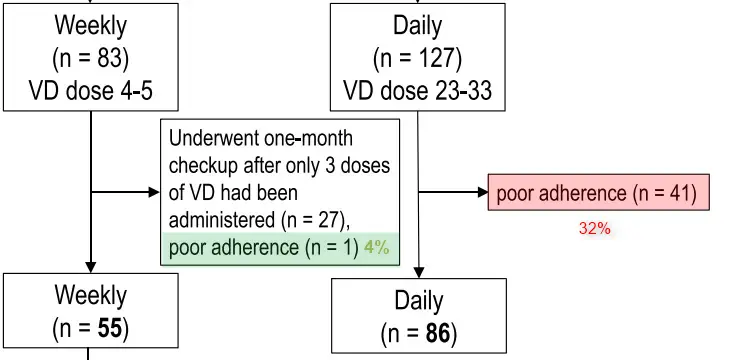
The frequencies of vitamin D insufficiency [25(OH)D < 20 ng/mL] were considerably reduced from 89.4 % in the control group to 20.0 % and 25.6 % in the weekly and daily groups, respectively [4]. Importantly, the adherence rate for weekly supplementation (98.8 %) was significantly higher than that for the daily supplementation (67.7 %, p < 0.001) group. None of the infants received excessive vitamin D, and there were no instances of hypercalcemia [4].
These findings have substantial clinical implications for regions without established vitamin D supplementation guidelines. A weekly regimen offers several practical advantages over a daily regimen, including improved parental adherence, convenient co-administration with vitamin K prophylaxis, and potential synergistic effects of vitamins D and K on bone health [4,5].
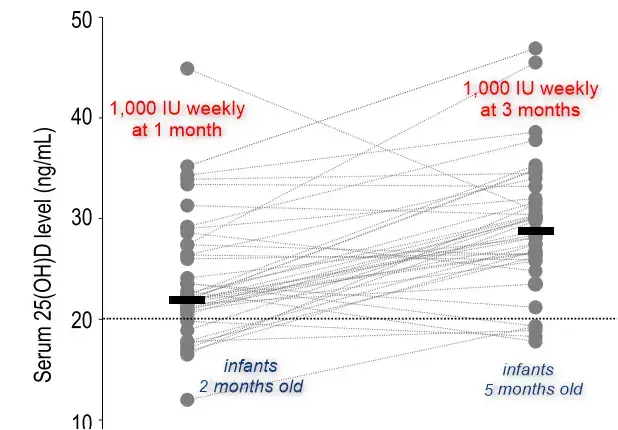
The strengths of the Hara-Isono et al. [4] study include its comparison of different supplementation regimens, its use of chemiluminescence immunoassays for accurate 25(OH)D measurements, and its investigation of both the efficacy and safety outcomes of weekly vitamin D supplementation [4]. However, the study's retrospective design, the differences in baseline characteristics between groups, and the relatively small sample size in the weekly supplementation group warrant the need for cautious interpretation of the findings [4]. Additionally, ~20 % of infants in the weekly group exhibited vitamin D insufficiency at 1 month, suggesting that higher doses may be needed for complete deficiency prevention.Hara-Isono et al. [4] identified that combining weekly vitamin D and vitamin K supplementation during early infancy can effectively prevent vitamin D insufficiency without causing vitamin D excess. The superior adherence rate to weekly rather than daily administration is an important advantage [4]. Further prospective randomized controlled trials are warranted to establish the optimal dosing strategies and evaluate long-term clinical outcomes, including bone health. This study provides compelling evidence that weekly vitamin D supplementation may serve as a practical and effective alternative to daily regimens for national prophylaxis policies in regions currently lacking specific guidelines.
References
1) Munns CF, Shaw N, Kiely M, Specker BL, Thacher TD, Ozono K, et al. Global consensus recommendations on prevention and management of nutritional rickets. J Clin Endocrinol Metab 2016;101:394-415.
2) Chu CH, Chen YC, Liu PY, Hu CC, Lin YL, Kuo FC, et al. Long-term epidemiological insights into rickets: a nationwide population-based retrospective study. Clin Exp Pediatr 2025;68:879-91.
3) Wagner CL, Greer FR. American Academy of Pediatrics Section on Breastfeeding, American Academy of Pediatrics Committee on Nutrition Prevention of rickets and vitamin D deficiency in infants, children, and adolescents. Pediatrics 2008;122: 1142-52.
4) Hara-Isono K, Morisawa K, Hida M, Iwamoto S, Ikeda K. Weekly vitamin D supplementation during early infancy as a potential strategy to prevent vitamin D insufficiency: a two-center retrospective study. Pediatr Neonatol 2026. S1875-9572 (25)00156-1. Online ahead of print.
5) Kidd PM. Vitamins D and K as pleiotropic nutrients: clinical importance to the skeletal and cardiovascular systems and preliminary evidence for synergy. Altern Med Rev 2010;15:199-222.
Charts from the study
Related in Vitamin D Life
- Children's Cancer hospital now testing vitamin D frequently and supplementing weekly
- 100,000 IU Vitamin D weekly for 4 weeks is safe and effective for children
- Better than Daily
- Weekly Vitamin D better than daily – lower cost, less pill burden, perhaps 1.5X better response – meta-analysis
- Monthly vitamin D dosing better for children than daily (again)
- Vitamin D for infants – 100,000 IU monthly is better than 400 IU daily – RCT
- Vitamin D every 25 days may be BETTER than daily – RCT
- Liposomal is better than standard Vitamin D in 10 ways (1 includes Liposomal Vitamin K)
- Liposomal Vitamin D appears to have a 3X faster and better response