Fortification of Vitamin D in Europe: Mostly Voluntary - April 2026
Vitamin D Fortification Strategies and Policy Landscape in Selected European Countries
Nutrients 2026, 18(8), 1194; https://doi.org/10.3390/nu18081194
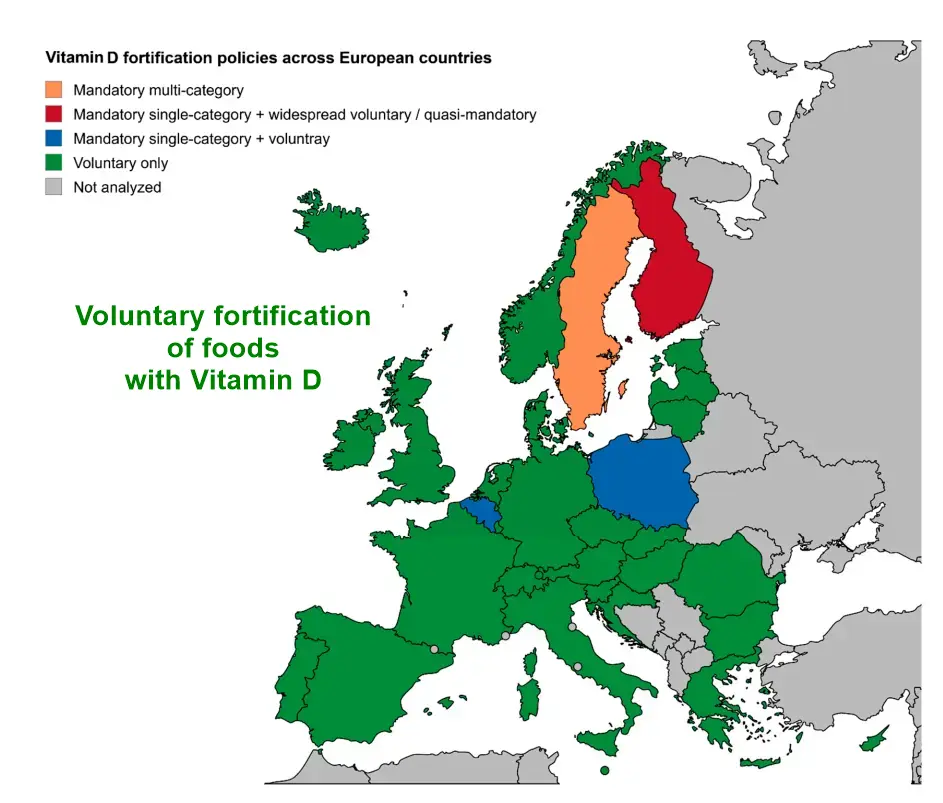
Background: Vitamin D deficiency remains a widespread public health issue in Europe, despite the availability of sunlight, dietary sources, supplements, and food fortification. National fortification strategies differ substantially in their regulatory approaches, food vehicles, and fortification levels, influencing the population’s vitamin D intake and status.
Objective: The primary objective of this study was to map vitamin D food fortification policies across European Union (EU) Member States, European Free Trade Association (EFTA) countries, and the United Kingdom (UK), focusing on regulatory frameworks, eligible food categories, and implementation models.
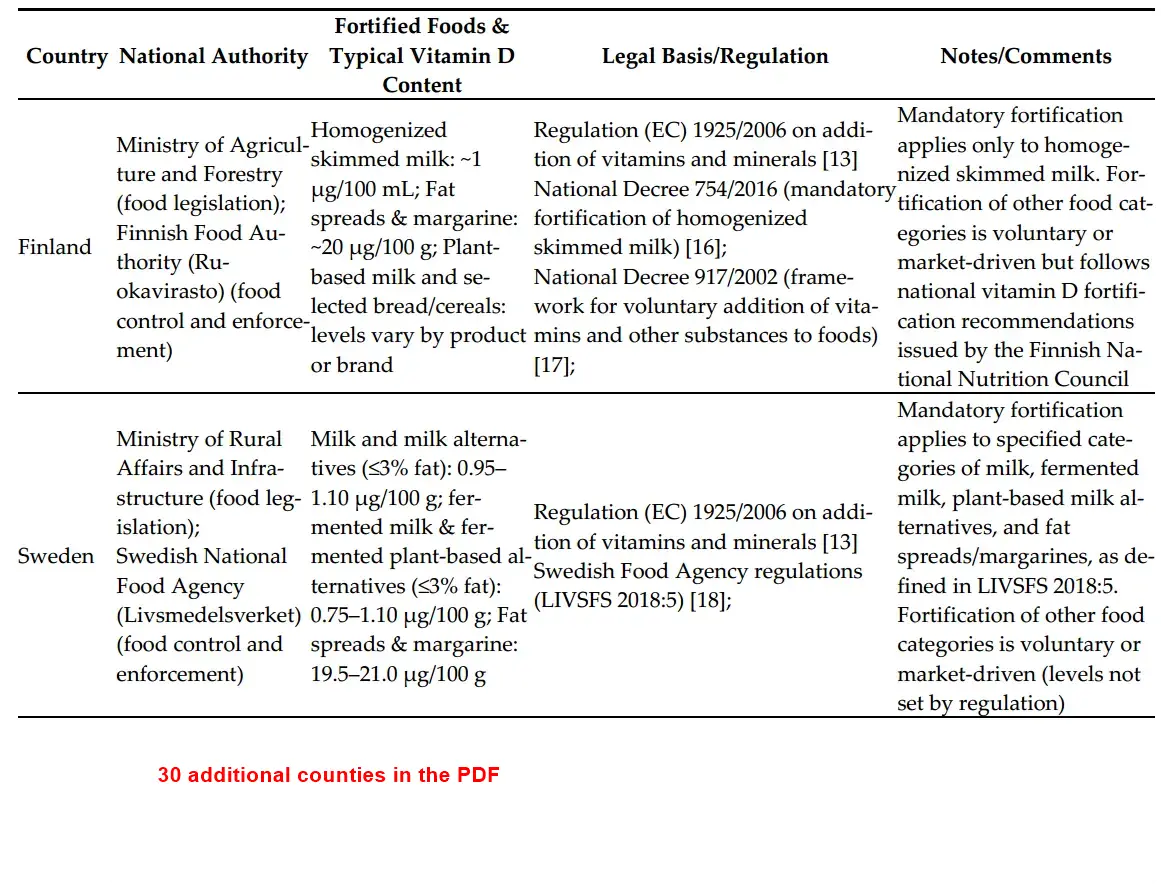
Methods: A structured review of national legislation and official guidance on vitamin D food fortification was conducted between December 2025 and March 2026 across EU Member States (n = 27), EFTA countries (n = 4), and the UK. For EU Member States, the framework established by Regulation (EC) No 1925/2006 was examined alongside national implementation measures. For EFTA countries and the UK, corresponding national legislation and official regulatory guidance were reviewed. Data were extracted on fortification policy status, eligible food categories, legal basis, and fortification levels. Targeted searches of PubMed and Scopus were performed to identify modeling studies and policy analyses supporting the interpretation of the findings. Results: Fortification policies show marked heterogeneity. Mandatory fortification is limited to a few countries and specific foods: Finland (homogenized skim milk), Sweden (low-fat milk, fermented dairy, plant-based alternatives, and fat spreads), Belgium (margarine and selected fats), and Poland (margarine and fat spreads). In most other European countries, vitamin D fortification is voluntary under EU legislation or equivalent national legislation, depending on market uptake. Food vehicles vary regionally, with Northern Europe extending fortification beyond fats to include fluid milk and plant-based drinks, whereas other regions mainly fortify margarines, cereals, dairy products, and plant-based beverages. Fortification levels also differ, with some countries specifying maximal or exact levels, while others lack national standards. Data on fortified foods are limited in several Central and Southern European countries. Modeling indicates that multi-vehicle fortification is more effective than single-vehicle approaches, safely increasing population intakes while reducing deficiency prevalence.
Conclusions: Vitamin D fortification policies across Europe are highly heterogeneous. Most countries rely on voluntary approaches, which provide limited coverage. Strengthening policy through mandatory and well-coordinated multi-vehicle strategies, informed by modeling and population-based studies, can improve vitamin D intake, reduce deficiency prevalence, and enhance health equity.
Related in Vitamin D Life
- After years of vitamin D fortification and supplementation, Finland has 38 ng levels
- Stillbirths dropped in 2 countries after increasing Vitamin D fortification (Finland, Sweden)
- Vitamin D has successfully fortified milk products, bread, orange juice, etc. – meta-analysis
- Fortification of foods: 1200 IU Vitamin D daily is safe
- Vitamin D home fortification- don't wait 100 years for your govt
- Increased Vitamin D has many benefits (Cancer deaths reduced by fortification in this case)*