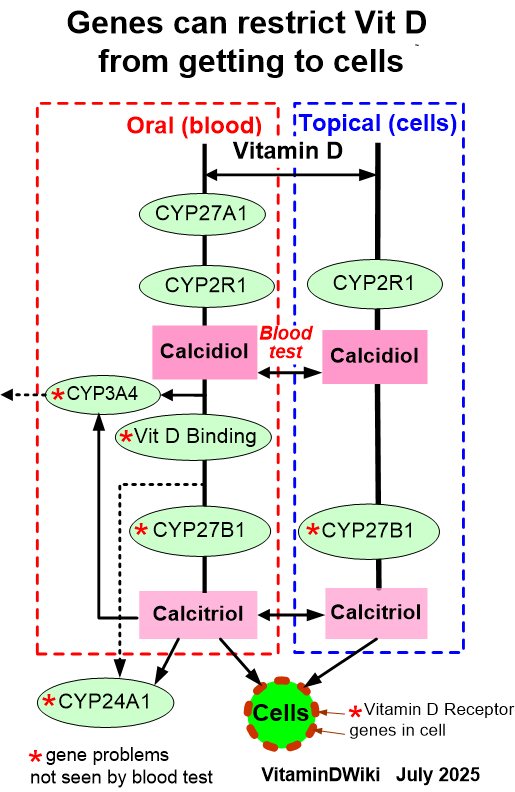
The tissues inside of your mouth (buccal) can activate some forms of Vitamin D
Local vitamin D3 bioactivation in oral tissue, from inactive to influential: A narrative review
Arch Oral Biol. 2026 Jun 8:189:106659. doi: 10.1016/j.archoralbio.2026.106659
Oleh Andrukhov 1, Sandra Hilberath 2, Marlies Holzmann 3, Markus Laky 4, Christian Behm 2
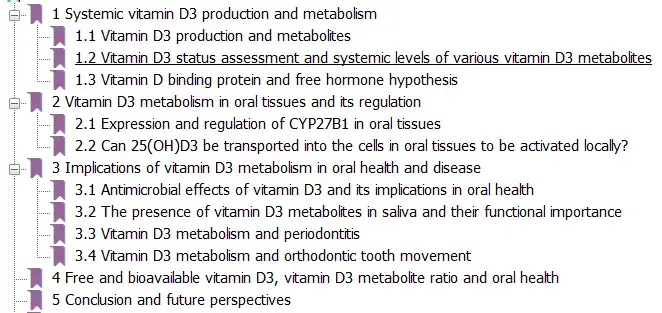
Table of Contents
Objectives: Vitamin D3 status profoundly affects oral health and disease. Over the last decade, evidence has emerged that vitamin D3 activation can also occur in peripheral tissues. This narrative review was conducted to critically analyze the state of the art about the presence and activity of enzymes involved in the bioactivation of vitamin D3 in the oral tissues.
Design: A comprehensive literature search was performed in PubMed and Google Scholar. The search included articles published in English without any time limit. Keywords included but not limited to the combinations of: "vitamin D3", "25(OH)D3", "1,25(OH)2D3", "oral tissues", "megalin", "CYP27B1", "extrarenal", and "antimicrobial peptides". Further studies were identified by screening the reference lists of the relevant publications.
Results: Various vitamin D3 metabolites influence the inflammatory response and the production of antimicrobial peptides in various oral cells. The enzyme CYP27B1, which is responsible for the conversion of 25(OH)D3 into 1,25(OH)2D3 and its bioactivation, is present in various oral tissues and cells. The existence and physiological significance of local vitamin D3 activation in oral tissues remain unclear. Most of 25(OH)D3 is bound to the vitamin D-binding protein (DBP) and must be dissociated for activation. It is unclear whether and how this uncoupling occurs in oral tissue.
Conclusion: Currently, there is rather indirect evidence that vitamin D3 could be bioactivated in oral tissues. Further studies on the local conversion of vitamin D3 to 25(OH)D3 and, subsequently, to 1,25(OH)2D3 in oral tissue, their regulation, and the role of free and bioavailable vitamin D3 metabolites are required.
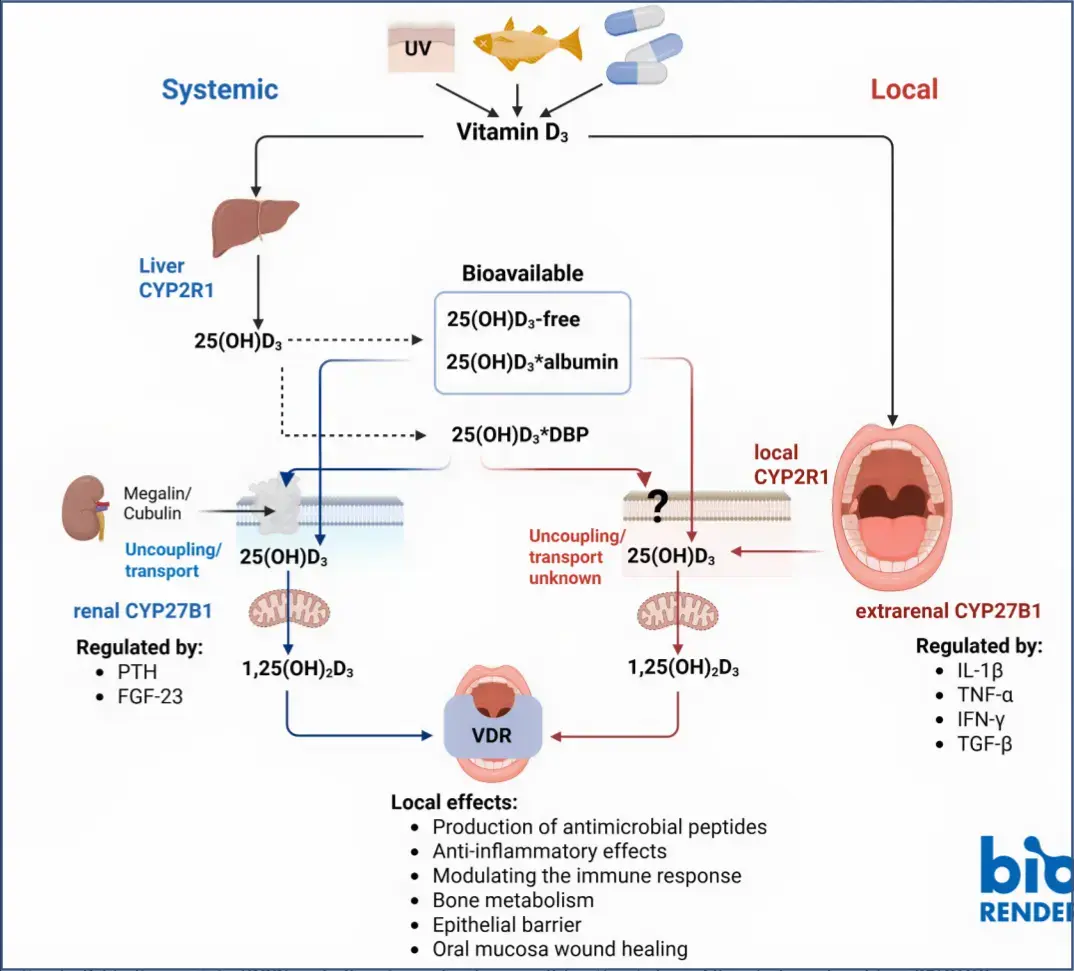
Fig. 1. Systemic and local vitamin D3 metabolism and its implications in oral tissues.
Vitamin D3 is produced in the skin upon exposure to UV light or can be obtained from certain foods and supplements.
The first step of systemic vitamin D3 activation is its conversion to 25(OH)D3, which happens in the liver. In the blood, most of 25(OH) D3 is bound to vitamin D binding protein (DBP) and albumin, and only a small fraction is free.
Albumin-bound and free 25(OH)D3 are considered bioavailable.
A further step of systemic vitamin D3 activation occurs in the kidney, where 25(OH)D3 is converted to the biologically active 1,25(OH)2D3.
This process is mediated by renal CYP27B1, which is regulated by parathyroid hormone (PTH) and fibroblast growth factor 23 (FGF− 23).
DBP-bounded 25(OH)D3 is uncoupled from DBP and transported into cells by megalin/cubulin complex, which is expressed in kidney proximal tubuli.
The enzymes responsible for vitamin D3 bioactivation are present in oral tissues.
In contrast to the kidney, CYP27B1 in oral tissues is regulated by inflammatory cytokines, particularly interleukin− 1β (IL− 1β), tumor necrosis factor-α (TNF-α), and interferon-γ (IFN-γ), as well as by transforming growth factor-β (TGF-β).
Bioavailable 25(OH)D3 can be locally activated in oral tissues.
It is unclear whether and how DBP-bounded 25(OH)D3 can be transported into oral cells.
The local effects of locally or systemically produced 1,25(OH)2D3 include the production of antimicrobial peptides and the regulation of inflammation, immune response, and bone metabolism.
Created in BioRender. Andrukhov, O. (2026) https://Bio Render.com/gv1pi3d.
Related in Vitamin D Life
- 35 tissues activate Vitamin D locally (Kidney not required)
- Perhaps 80% of Vitamin D activation is done by cells (not kidneys) - 2008
- Kidney may not be required to activate Vitamin D
- Fully-activated Vitamin D (Calcitriol) is produced inside and outside of the kidneys
- Skin can create and activate vitamin D – kidney not needed
- Vitamin D sprayed inside cheeks (buccal spray) - several studies
- Topical Vitamin D provides more benefits than oral sometimes - many studies
- Genetics contains