
Review of Vitamin D Evidence and Controversies - 2026
Vitamin D and Health Outcomes: State-of-the-Art Review of Triangulated Evidence and Ongoing Controversies
Current Nutrition Reports (2026) 15:26 https://doi.org/10.1007/s13668-026-00748-2REVIEW
Maria Dalamaga © • Rodopi Emfietzoglou1 • Dimitra Petropoulou1 • Maria Kypraiou • Dimitris C. Kounatidis • Natalia G. Vallianou • Spyridon Karras • Faidon Magkos • Irene Karampela7
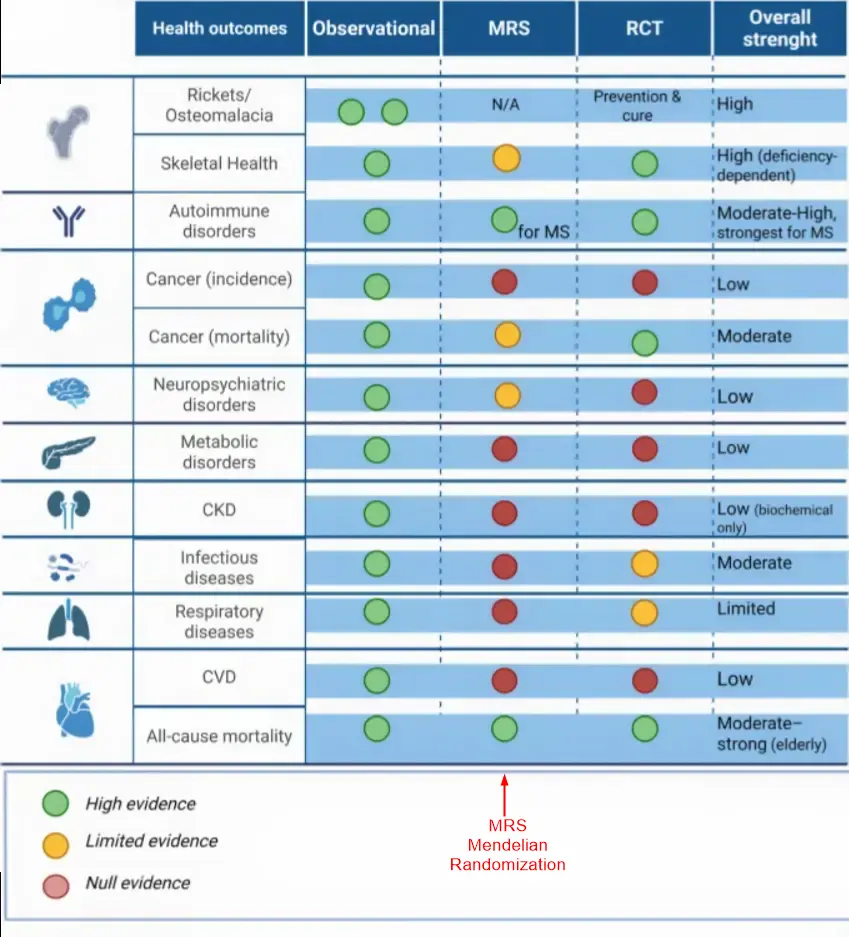
Purpose of Review Vitamin D is a pleiotropic hormone with an established role in skeletal integrity and broader actions in immune regulation, inflammation, cellular proliferation, and energy homeostasis. Despite decades of research, its extra-skeletal effects remain controversial, largely due to discordant findings across observational studies, Mendelian randomization studies (MRS), and randomized controlled trials (RCTs). Unlike many prior reviews, this state-of-the-art review synthesizes triangulated evidence across these study designs to clarify outcome-specific causal relationships and ongoing controversies.
Recent Findings Triangulated evidence provides strong and consistent support for a causal role of vitamin D in skeletal health, particularly in the prevention and treatment of rickets and osteomalacia, and in fracture risk reduction among vitamin D-deficient and older populations. For selected extra-skeletal outcomes, modest and threshold-dependent benefits are observed, including reductions in cancer mortality, protection against autoimmune disorders, most convincingly multiple sclerosis, and decreased risk of acute respiratory infections, including COVID-19, primarily in individuals with low baseline 25(OH)D concentrations.
In contrast, associations with cardiovascular disease, metabolic disorders, obesity, and most neuropsychiatric outcomes are not consistently supported by genetic or interventional evidence, suggesting limited or non-causal effects. Across outcomes, evidence indicates a non-linear relationship between vitamin D status and health, with increased risk concentrated at low 25-hydroxyvitamin D concentrations and limited benefit beyond sufficiency.
All-cause mortality shows a modest, threshold-dependent association, with supplementation benefits largely confined to deficient or older populations.
Key challenges include
- assay variability,
- non-linear dose-response relationships, and
- RCT designs that frequently enroll vitamin D-replete populations,
resulting in substantial methodological heterogeneity and limiting causal inference.
Summary Overall, the presented triangulated model may reconcile longstanding inconsistencies by reframing vitamin D as a context-dependent determinant of health. These findings argue against indiscriminate population-wide supplementation and support targeted strategies focused on the identification and correction of deficiency. Vitamin D should be regarded neither as a universal panacea nor as a trivial supplement, but as a context-dependent hormone whose clinical value lies in outcome-specific correction of deficiency.
Challenges ignored by the review include:
- Failure to use gut-friendly Vitamin D for people with poor gut function
- Failure to increase the dose size for Overweight/obese people
- Failure to offer other forms when the participant is reluctant to take capsules - 20%?
- RCTs often have poor compliance for daily supplementation.
Weekly and bi-weekly have much better compliance - Vitamin D often needs co-factors like Magnesium
- RCTs often choose from a pool of otherwise healthy people. Which is not the real world
- Why Mendelian randomization fails with Vitamin D