
Poor adherence to taking Vitamin D daily (Adult ADHD in this case)
Overcoming Adherence Barriers in Adult ADHD: A Narrative Review of Cumulative Vitamin D Supplementation Strategies.
J. of Education, Health and Sport. June 2026 https://doi.org/10.12775/JEHS.2026.93.72539
Poland
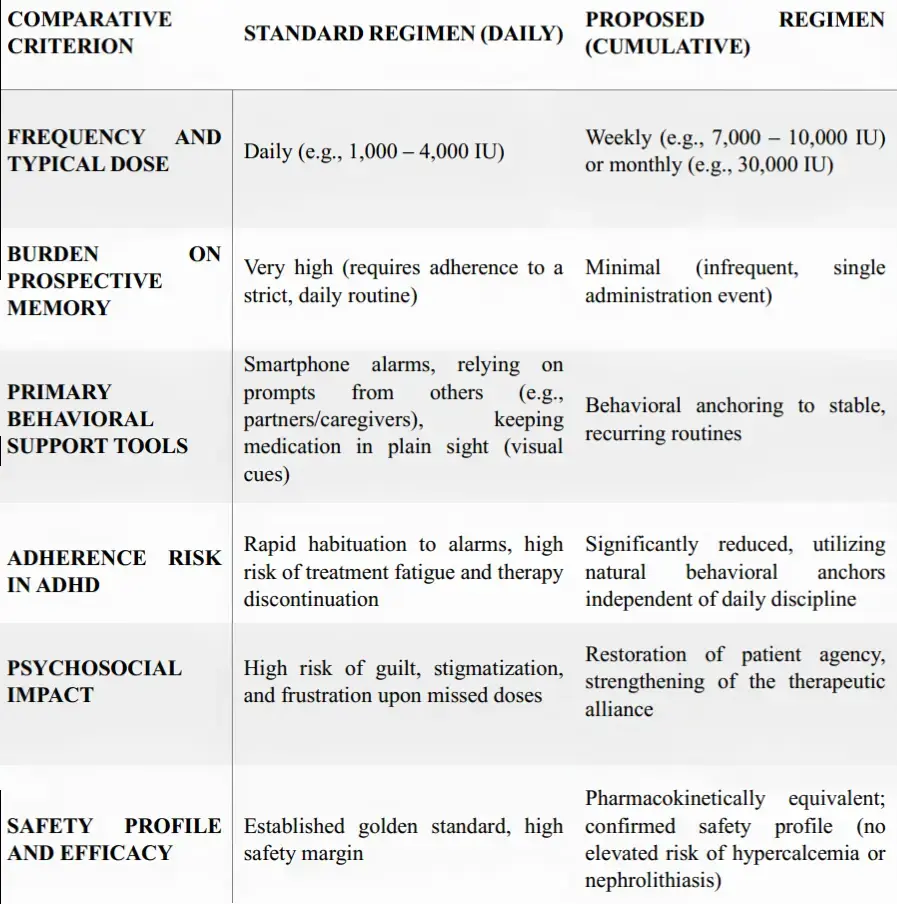
Background. Vitamin D is an essential neurosteroid affecting the central nervous system and dopaminergic pathways. Adults with attention-deficit/hyperactivity disorder (ADHD) are particularly susceptible to its deficiency. Adherence to daily supplementation can be a major challenge for them. ADHD-specific executive dysfunction and memory deficits make daily routines demanding, often causing treatment discontinuation. This untreated deficiency exacerbates core symptoms of the disorder.
Aim. This narrative review provides a rationale for using cumulative, infrequent vitamin D dosing to reduce memory reliance and improve adherence among adults with ADHD.
Materials and methods. We searched the PubMed, Scopus, and Google Scholar databases. Data from guidelines, meta-analyses, reviews, randomized controlled trials (RCTs), and qualitative research on neurobiology, pharmacokinetics, safety, and behavioral sciences were synthesized regarding therapeutic adherence.
Results. Adults with ADHD exhibit high rates of daily medication non-adherence due to their cognitive profile. Intermittent cumulative dosing (e.g., 10,000 IU weekly or 30,000 IU monthly) is as effective as daily dosing in maintaining optimal 25-hydroxyvitamin D [25(OH)D] levels.
Large trials show that monthly boluses (up to 100,000 IU) are safe and do not increase the risk of hypercalcemia. Nearly 78% of patients prefer infrequent dosing, facilitating behavioral strategies like habit anchoring by reducing memory demands.
Conclusion. Replacing daily supplementation with a cumulative regimen bypasses ADHD-specific cognitive barriers. Integrating infrequent dosing with behavioral techniques improves long-term adherence. Future RCTs are needed to develop tailored clinical guidelines.
Clipped from PDF: Habit Stacking
4.2. Behavioral strategies: Habit stacking and event-based anchoring
It should be noted, however, that the doctor must not leave the patient alone with the task of remembering the medication; rather, they should equip them with effective behavioral tools. As research shows,36 relying solely on smartphone reminder apps and alarms is ineffective for building habits over the long term. Significantly better results in establishing lasting health behaviors are achieved through the technique of habit stacking. The physician can help the patient link the moment of taking a monthly dose of the vitamin with a strong, regular, and certain point in their calendar - for example, payday or the day bills are paid. Another unconventional yet practical solution for female patients is to link supplementation to the menstrual cycle; storing vitamin D capsules alongside hygiene products ensures the medication is taken on the first day of bleeding, without relying on overburdened prospective memory (provided the patient has a relatively regular cycle).
A key condition for the success of the habit stacking technique, however, is the selection of a sufficiently stable base activity (a so-called anchor). Patients with ADHD very often report that attempts to maintain adherence by linking medications to daily, fluid routines fail because they forget to perform the baseline activity itself. This is perfectly illustrated by qualitative research, in which one patient explicitly describes this cognitive trap: "I tried to adhere because I wanted to take it when I was eating and that was the main problem because I always forget breakfast to eat or I eat very late like 2 or something."37 Therefore, the optimal baseline events for less frequent doses are those that are maximally stable and unchanging - those that do not depend solely on the patient's internal discipline and memory but constitute a regular external or biological factor that affects them in a predetermined manner.
The implementation of such personalized and empathetic solutions brings mutual benefits. It increases satisfaction for both patients, who regain a sense of agency in the treatment process, and physicians, who observe real improvements in health outcomes. From a broader perspective, effective prophylaxis and early correction of vitamin D deficiencies, before severe complications develop, provide significant relief to the healthcare system.
Vitamin D Life: not forget, higher gradient (more vitamin gets to cells)
- Adherence of children taking vitamin D supplements
- Children had a better response to Vitamin D given every 2 weeks than daily – RCT
- Weekly, Monthly Vitamin D are typically better than daily - many studies
- Better than Daily
- Vitamin D given weekly better than daily (Nursing home, 5,600 IU weekly)
- Vitamin D given daily, weekly, or monthly has similar response (116 RCTs) – meta-analysis
- Vitamin D every 25 days may be BETTER than daily – RCT
- Monthly vitamin D dosing is better than daily dosing for children and elderly (more likely to be taken)
- Optimal vitamin D supplementation strategies (D3 - weekly or monthly)
- Quality of life of seniors increased by monthly 60,000 IU of Vitamin D - Nov 2025
- Increased those taking Vitamin D daily in nursing home from 45% to 78% with a lot of effort (higher % if weekly to monthly)
- Weekly, Monthly Vitamin D are typically better than daily - many studies