
Obesity lowers vitamin D which increases probability of diabetes in children
Vitamin D Deficiency in Obese Children and Its Relationship to Glucose Homeostasis.
J Clin Endocrinol Metab. 2011 Nov 9.
Olson ML, Maalouf NM, Oden JD, White PC, Hutchison MR. [email protected]
Departments of Pediatrics (M.L.O., J.D.O., P.C.W., M.R.H.) and Internal Medicine (N.M.M.), University of Texas Southwestern Medical Center, Dallas, Texas.
Objectives:The aim of the study was to compare the prevalence of vitamin D deficiency in obese and non-overweight children in North Texas, to examine relationships between dietary habits and 25-hydroxyvitamin D [25(OH)D] level in obese children, and to examine the relationship between 25(OH)D level and markers of abnormal glucose metabolism and blood pressure.
Patients and Methods:Using a cross-sectional design, systolic and diastolic blood pressure, dietary information, serum 25(OH)D, fasting glucose and insulin, 2-h glucose from oral glucose tolerance test, hemoglobin A1c, and homeostasis model assessment of insulin resistance were recorded for 411 obese subjects (6-16 yr old) at an obesity referral clinic. 25(OH)D was also obtained from 87 control non-overweight subjects (6-16 yr old).
Results:Ninety-two percent of obese subjects had a 25(OH)D level below 75 nmol/liter, and 50% were below 50 nmol/liter.
Among non-overweight subjects, these frequencies were 68 and 22%, respectively (both P < 0.01 compared with obese subjects).
25(OH)D was negatively associated with
soda intake (P < 0.001), (see Cola Soft Drinks reduce Calcium and vitamin D)
juice intake (P = 0.009), and
skipping breakfast (P < 0.001).
25(OH)D was negatively correlated with
homeostasis model assessment of insulin resistance (r = -0.19; P = 0.001) and
2-h glucose (r = -0.12; P = 0.04)
after adjustment for body mass index and age but was not correlated with hemoglobin A1c, systolic blood pressure Z score, or diastolic blood pressure Z score.
Conclusions:Vitamin D deficiency is common in children in this southern United States location and is significantly more prevalent in obese children.
Lower 25(OH)D level is associated with risk factors for type 2 diabetes in obese children.
PMID: 22072738
– – – – – – – – – – – – –
Clipped from review by MedPageToday
And half of the obese children had vitamin D deficiency, compared with 22% of thinner kids, Hutchison and colleagues reported in the January issue of the Journal of Clinical Endocrinology & Metabolism.
They were compared with 87 children -- matched to the obese group by season when the data was acquired, age, and race/ethnicity -- who were below the 85th percentile of BMI for age. They were a convenience sample of otherwise healthy patients being treated for congenital hypothyroidism, acquired primary hypothyroidism, or isolated growth hormone deficiency.
On average, the obese children had a serum 25(OH)D concentration of 49 nmol/L, compared with 67.5 nmol/L for the slimmer cohort. The difference was significant at P<0.0001.
"Our study found that obese children with lower vitamin D levels had higher degrees of insulin resistance," said lead author Micah Olson, MD, also of the University of Texas Southwestern Medical Center.
See also Vitamin D Life
Virtually all Native American children low on vitamin D and had indications of diabetes – Oct 2011
25 percent reduction in diabetes risk if vitamin D great than 30 ng - June 2011
90 percent of Dark Skinned diabetics had less than 30 ng of vitamin D – July 2011
Diabetes rising quickly in areas with recent air conditioning – June 2011 lots of good graphics. maps
Obesity and diabetes reduced when move to better neighborhood – or better UV – Oct 2011
Pre-diabetes and hypertension 2.4X more common when less than 30 ng of vitamin D – Jan 2011
Dark skinned teens use media much more - June 2011 good graphic
Metabolic Syndrome
Metabolic syndrome category listing has items along with related searches
70 percent increased chance of Metabolic Syndrome if low on vitamin D – May 2011
Metabolic Syndrome and vitamin D - view of many papers - Aug 2010
Metabolic Syndrome 50 percent more likely if under 20 ng of vitamin D – May 2011
Vitamin D and Obstetrics Improving Pregnancy and Childbirth - presentations May 2011 has the following
7X less diabetes for children with> 2,000 IU of vitamin D daily
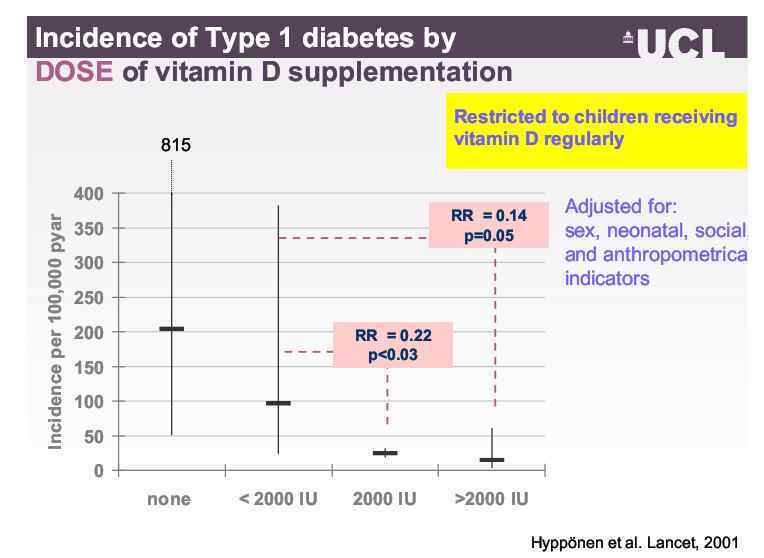
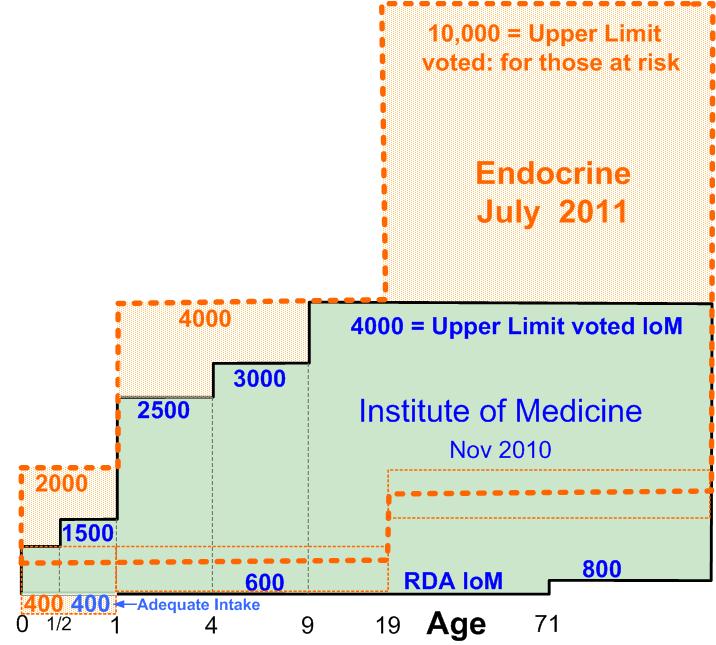
Vitamin D Recommendations has the following graph by Endocrine Society - which published this paper
Following graph shows the decrease in vitamin D with increasing BMI
2 nanograms/ml less vitamin D for every in 5 kg/m✻✻2 increase in BMI

Overview Deficiency of vitamin D has the following graphic
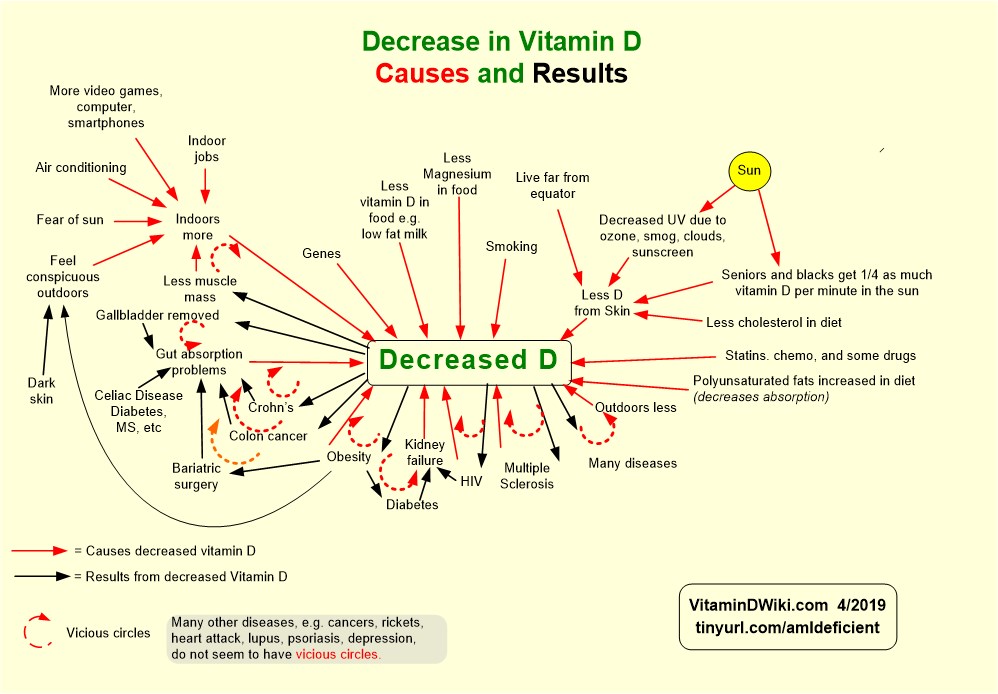
Items in both categories Obesity and Diabetes:
{category}
Items in both categories Metabolic Syndrome and Diabetes:
{category}