Many domesticated animals need Vitamin D - April 2026
Role of Vitamin D Supplements in Animal Diets and Their Effectiveness Along with Safety Considerations
Unique Scientific Publishers, Faisalabad, Pakistan, pp: 246-251. https://doi.org/10.47278/book.HH/2025.442
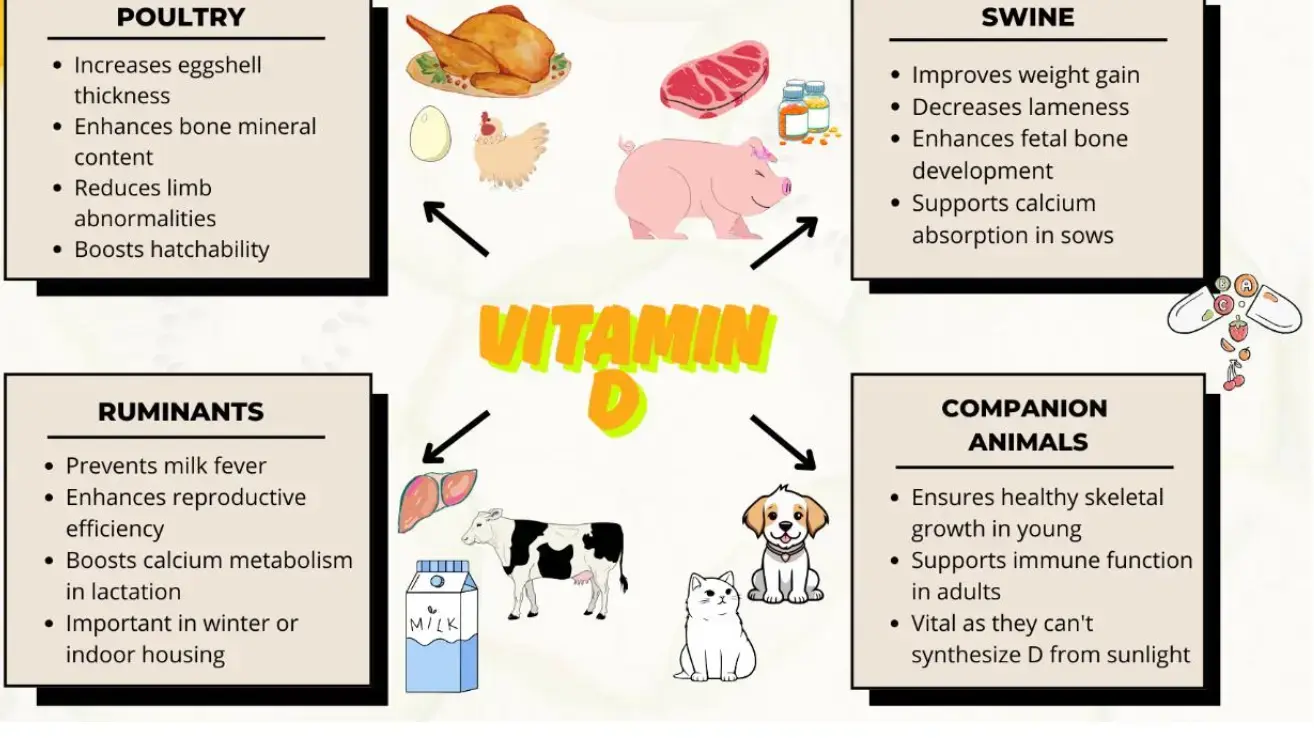
Vitamin D supplements play in animal nutrition and the potential risks to safety. Numerous physiological functions, including the metabolism of calcium and phosphorus, bone formation, immune system function, muscle growth, and reproduction, depend on vitamin D. Supplementation is required since many animals, particularly those kept in enclosed spaces like industrial farms, do not get enough sun exposure to produce vitamin D naturally. Ergocalciferol (D2) and cholecalciferol (D3), the two primary forms of vitamin D used in animal feed. D3 has a better bioavailability and a more physiological role. It emphasizes the necessity of a tailored supplementation approach to meet the unique needs of different species and production systems and the potential risks of toxicity and insufficiency. Progress in vitamin D supplementation, including the development of improved metabolites such as 25-hydroxyvitamin D3, and the necessity of dietary intake monitoring to avoid excess. To improve animal health, productivity, and welfare while resolving safety concerns, this study aims to inform evidence-based decision-making in animal nutrition through a comprehensive evaluation of the body of existing literature and practical applications. It is recommended that future studies look at sustainable vitamin D sources and the best supplementation techniques in line with evolving farming methods.
Related in Vitamin D Life (cows, chickens, dogs, cats, and various pet birds)
- Overview Veterinary and vitamin D
- Ducks produced more egg per gram of feed if add Vitamin D (3200 IU per kg of dry feed)
- Many Vitamin D similarities: people and cows
- Hens with Vitamin D were better in at least 5 ways – RCT
- Dairy cattle have 70 ng of vitamin D if supplementation equal to 5,000 IU for human
- Veterinarians often giving more vitamin D than govt upper limit - 2012
- Veterinary and D
- Sun-cured hay often has 2000 IU of vitamin D per kilogram
- Fish need vitamin D and C for their bones
Dogs and Cats
- Vitamin D: A Predictor of Diseases in Dogs and Cats
- Pet health improved by Vitamin D
- Dogs health increased by Vitamin D
- Cats often have similar range of Vitamin D as humans - 10 to 30 ng
- Half of dogs now get cancer, it used to be just 1 percent (probably low Vitamin D)
- Dogs, like humans, need vitamin D for many reasons
- Companion animals (dog, cats) need vitamin D too
- Dog Cancer 4X more likely if low Vitamin D
- Hospitalized cats 8X more likely to die if low vitamin D (Vit. D helps humans too)