
Inflammatory biomarkers reduced by Vitamin D - umbrella analysis of 97 RCTs
The effects of vitamin D supplementation on inflammatory biomarkers: an umbrella study of meta-analysis on randomized controlled trials - June 2026
Inflammopharmacol (2026). https://doi.org/10.1007/s10787-026-02266-7 PDF behind paywall
Chou-Yi Hsu, Hassan Youssef Hussein, Karam Akram Al-akkam, Tushar B. Gajjar, Hamad AlMohamadi, Nodir Khonturaev, Sandeep Kumar Shukla, Safa Hussien Radhi, Aseel Smerat & Muhammad Shahid Iqbal
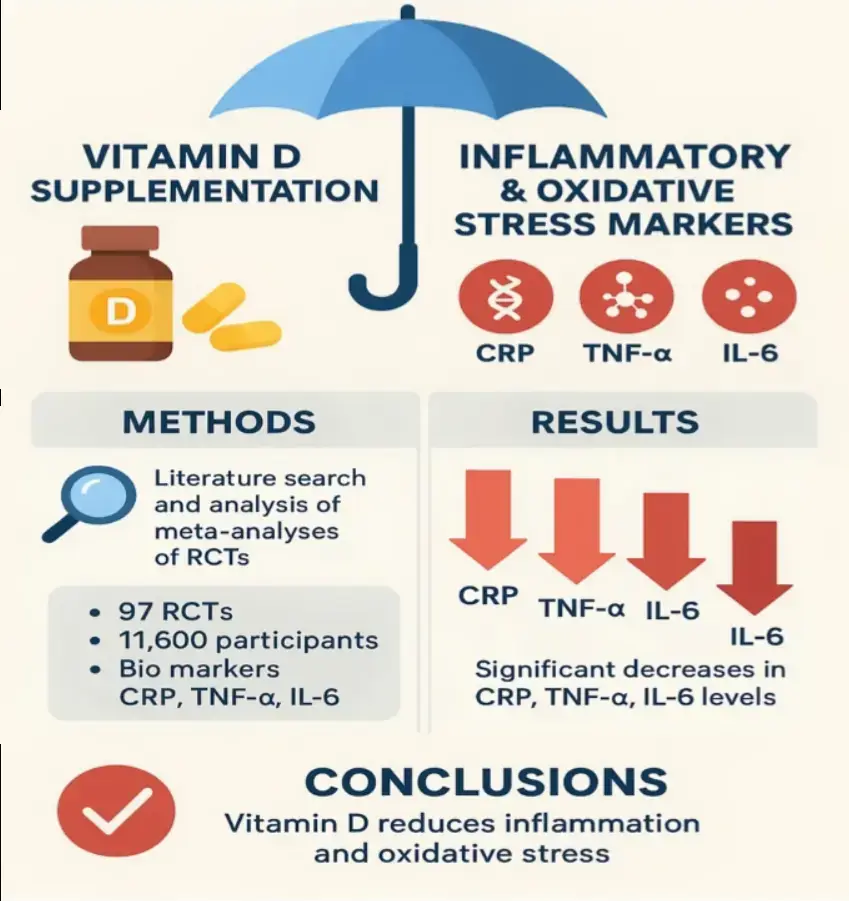
BackgroundVitamin D regulates bone metabolism and immune function, influencing inflammatory biomarkers such as CRP, TNF-α, and IL-6. Evidence from RCTs and meta-analyses on its anti-inflammatory effects remains inconsistent. To synthesize evidence from meta-analyses of RCTs on vitamin D supplementation and its effects on circulating inflammatory biomarkers, and to assess the quality and certainty of this evidence.
MethodsA comprehensive literature search was conducted in PubMed, Embase, Web of Science, and Scopus from inception to January 2025. Eligible studies included systematic reviews and meta-analyses of RCTs reporting effects of vitamin D supplementation on inflammatory markers (CRP, hs-CRP, TNF-α, IL-1β, IL-6, IL-8, IL-10, oxidative stress markers, IgE). Data extraction was performed independently by two reviewers. Methodological quality was assessed using AMSTAR-2, and the certainty of evidence was graded with GRADE. Corrected Covered Area (CCA) was calculated to quantify overlap among primary studies.
ResultsThis umbrella review analyzed seven meta-analyses covering 97 RCTs with ~ 11,600 participants on vitamin D supplementation’s effects on inflammation and oxidative stress markers. Vitamin D significantly reduced CRP, TNF-α, and IL-6 levels in individuals with abnormal glucose homeostasis (Hedges’g = − 0.67, − 0.81, and − 1.93, respectively; p < 0.001), and improved oxidative stress markers in pregnant women, evidenced by decreased MDA (Hedges’g = − 0.46) and increased TAC (Hedges’g = 2.13) and glutathione (Hedges’g = 4.37). In type 2 diabetes, a significant reduction in hs-CRP (Hedges’g = − 0.45, p = 0.005) and TNF-α (Hedges’g = − 0.75, p = 0.05) was observed. Conversely, studies in obese/overweight and asthmatic populations revealed no significant changes in inflammatory markers, except for a highly heterogeneous and potentially unreliable increase in IL-10 among asthma patients (Hedges’g = 18.85, p = 0.04).
ConclusionsVitamin D supplementation exerts significant anti-inflammatory and antioxidant effects, particularly in metabolic disorders, though evidence remains heterogeneous across populations and biomarkers.