
HPV and Vitamin D - several studies
HPV warts treated by both Intralesional and topical Vitamin D - March 2024
Vitamin D and HPV infection: Clinical pearls
J Cosmet Dermatol. 2024 Mar 15. doi: 10.1111/jocd.16280
Zeinab Aryanian 1 2 3, Kamran Balighi 1 3, Azadeh Goodarzi 4 5, Zeinab Mohseni Afshar 6, Parvaneh Hatami 1
📄 Download the PDF from Vitamin D Life
Note: Both methods provide a much higher concentration of wart Vitamin D than from oral Vitamin D (topical Vitamin D provides a higher concentration)
HPV and Vitamin D association - no consensus - Review Jan 2024
Relationship between human papillomavirus and serum vitamin D levels: a systematic review
BMC Infect Dis. 2024 Jan 13;24(1):80. doi: 10.1186/s12879-024-09006-8.
Seyedeh Maryam Khalili 1, Elnaz Haji Rafiei 1, Marjan Havaei 1, Leila Alizadeh 1, Fereshte Ghahremani 1, Zohreh Keshavarz 2, Ali Montazeri 3 4, Hedyeh Riazi 5
Background: Human papillomavirus (HPV) is one of the most prevalent sexually transmitted diseases worldwide. The present review was conducted to accumulate evidence on the relationship between cervicovaginal human papillomavirus infection and serum vitamin D status.
Methods: Electronic databases including Web of Science, Embase, Scopus, and PubMed were searched by different combinations of keywords related to "human papillomavirus" and "vitamin D", obtained from Mesh and Emtree with AND, and OR operators without any time restriction until December 24, 2022. Selection of articles was based on the inclusion and exclusion criteria. Newcastle-Ottawa Scale was used for quality assessment. The Preferred Reporting Items for Systematic Reviews and Meta-Analyses (PRISMA) checklist was applied for reporting.
Results: In total, 276 citations were retrieved. After removing duplicates, and non-related articles, the full texts of 7 articles were reviewed including 11168 participants.
Three studies reported that there was a positive relationship between vitamin D deficiency and cervicovaginal human papillomavirus while
Three studies did not.
One study showed a significant positive association between higher vitamin D stores and short-term high-risk human papillomavirus persistence.
Conclusions: The findings showed no firm evidence for any association between serum vitamin D level and cervicovaginal human papillomavirus infection, although the possible association could not be discarded. Further investigations are needed to reach sound evidence.
📄 Download the PDF from Vitamin D Life
300,000 IU monthly oral Vitamin D got levels to only 24 ng, no HPV benefit - 2021
The effect of vitamin D on the regression of human papilloma virus infection and metabolic parameters: a retrospective study
EUROPEAN J. OF GYNAECOLOGICAL ONCOLOGY, vol.42, no.2, pp.340-345, 2021 10.31083/j.ejgo.2021.02.2246
Koc S., KURT S., İLGEN O., Timur H. T., Uslu T.
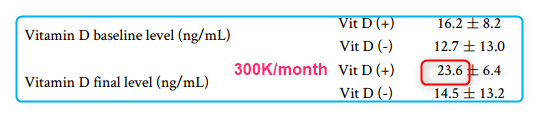
Purpose: Human papillomavirus (HPV) is the primary cause of cervical cancer. Our study aims to evaluate the effects of vitamin D on HPV regression, related cytological pathologies and various metabolic parameters.
Materials and methods: 100 high-risk HPV positive patients, who were detected from hospital database, were divided into 2 groups as those who received vitamin D supplements (n = 50) and did not receive vitamin D supplements (n = 50). We determined the changes in serum vitamin D concentrations, metabolic parameters of patients and regression of HPV after 6 months. Then, we compared the results of patients who took vitamin D supplements, and those who did not.
Results: Patient characteristics of both groups were similar in terms of smoking, using oral contraceptives, operation status, body mass index, and mean age of first coitus. Considering the findings of our study, the difference in rate of HPV regression was not significant in the group with a history of vitamin D use (P = 0.804). Regarding metabolic parameters, we observed significant decrease in insulin (P < 0.001), triglyceride (P = 0.019), and CRP (P < 0.001) levels in the group with a history of vitamin D use.
Conclusion: According to our findings, vitamin D supplementation does not significantly increase the rate of HPV regression. On the other hand, its metabolic effects are noteworthy. It has positive effects on glucose homeostasis and lipid profile. In the light of previous studies, vitamin D may be helpful in the treatment of vaginal infections, nonetheless it is not a as effective concerning cervical HPV infections.
📄 Download the PDF from Vitamin D Life
HPV 1.8X more likely if low Vitamin D - Nov 2020
Understanding the role of emerging vitamin D biomarkers on short-term persistence of high-risk HPV infection among mid-adult women - Nov 2020
J Infect Dis,. 2020 Nov 17;jiaa711. doi: 10.1093/infdis/jiaa711
Catherine Troja 1, Andrew N Hoofnagle 2, Adam Szpiro 3, Joshua E Stern 4, John Lin 1, Rachel L Winer 1
Background: Associations between vitamin D biomarkers and persistent high-risk human papillomavirus (hrHPV) detection have not been evaluated.
Methods: 2011-2012 stored sera from 72 women ages 30-50 years with prevalent hrHPV (n=116 type-specific infections) were tested for 5 vitamin D biomarkers: 25(OH)D and 4 emerging biomarkers, 1,25(OH)2D, 24,25(OH)2D, free vitamin D, and vitamin D binding protein (DBP). hrHPV detection patterns (persistent versus transient/sporadic) were determined using cervicovaginal swabs collected monthly for 6 months. Associations between vitamin D and short-term type-specific hrHPV persistence were estimated using logistic regression. Our primary exposure was continuous 25(OH)D, with additional biomarkers evaluated as secondary exposures. Primary models adjusted for age, race, BMI, education, contraceptives, smoking, season, and calcium/phosphate levels. Sensitivity analyses restricted from 19 hrHPV types to 14 used in cervical cancer screening.
Results: In primary analyses, non-significant positive associations with hrHPV persistence were observed for measures of 25(OH)D and 24,25(OH)2D. Associations were stronger and significant restricting to 14 hrHPV types (25(OH)D per 10ng/mL increase:
aOR=1.82,95%CI:1.15-2.88 and
aOR=4.19,95%CI:1.18-14.88 DBP-adjusted;
25(OH)D≥30 vs <30ng/mL: aOR=8.85,95%CI:2.69-29.06;
24,25(OH)2D: aOR=1.85,95%CI:1.18-2.88).
1,25(OH)2D was unassociated with persistence.
Conclusions: Serum vitamin D measured by multiple biomarkers showed positive associations with short-term hrHPV persistence that were significant only when restricting to 14 clinically-relevant hrHPV types.
HPV 3X more likely if low Vitamin D - 2016
Association Between Serum 25-Hydroxyvitamin D Level and Human Papillomavirus Cervicovaginal Infection in Women in the United States.
J Infect Dis. 2016 Jun 15;213(12):1886-92. doi: 10.1093/infdis/jiw065
Shim J1, Pérez A2, Symanski E3, Nyitray AG3.
1 Department of Business Intelligence and Analytics, Texas Children's Health Plan, Houston.
2 Department of Biostatistics, University of Texas School of Public Health, Austin.
3 Department of Epidemiology, Human Genetics, and Environmental Sciences, University of Texas School of Public Health, Houston.
📄 Download the PDF from Vitamin D Life
BACKGROUND:
A sufficient level of vitamin D enhances protection against several infectious diseases; however, its association with cervicovaginal human papillomavirus (HPV) infection has not been studied.
METHODS:
Data for this cross-sectional study were from National Health and Nutrition Examination Survey 2003-2006. A total of 2353 sexually active women for whom cervicovaginal HPV infection status and serum 25-hydroxyvitamin D (25[OH]D) level were known were studied. Associations between serum 25(OH)D levels (continuous and categorical forms) and cervicovaginal HPV infection (due to high-risk HPV or vaccine-type HPV) were estimated using weighted logistic regression.
RESULTS:
After adjustment for age, race/ethnicity, and marital status, the odds of high-risk HPV infection were increased per each 10 ng/mL decrease in serum 25(OH)D level (adjusted odds ratio [aOR], 1.14; 95% confidence interval [CI], 1.02-1.27). Similarly, the odds of vaccine-type HPV infection were increased in women with vitamin D levels that were severely deficient (serum 25[OH]D level, <12 ng/mL; aOR, 2.90 ; 95% CI, 1.32-6.38), deficient (12-19 ng/mL; aOR, 2.19; 95% CI, 1.08-4.45), and insufficient (20-29 ng/mL; aOR, 2.19; 95% CI, 1.22-3.93), compared with those with vitamin D levels that were sufficient (≥30 ng/mL).
CONCLUSIONS:
Cervicovaginal HPV prevalence is associated with less-than-optimal levels of serum vitamin D.
See also web
40 HPV strains cause Cancer Mercola Dec 2022
cervical, penile, oral, vaginal, vulvar and anal cancer.
"Ninety percent of HPV infections resolve on their own without treatment, as a well-functioning immune system will keep the virus in check. In rare cases, however, infection with a high-risk HPV that remains untreated and unchecked may turn into cancer."
"In the U.S., 3% of all cancers in women and 2% of cancers in men are related to untreated chronic HPV infection.2"
7 Million American Men Carry Cancer-Causing HPV NYT Oct 2017
- "The study, in the Annals of Internal Medicine, found that 11 million men and 3.2 million women in the United States had oral HPV infections. Among them, 7 million men and 1.4 million women had strains that can cause cancers of the throat, tongue and other areas of the head and neck."
- “The difference in oral HPV infection between smokers and nonsmokers is staggering,” Note by Vitamin D Life: Smoking reduces vitamin D - many studies
- Natural Herbal HPV "Cure" Discovered GreeMedInfo Jan 2018
- curcumin (which activates the vitamin D receptor), reetha, amla and aloe vera vaginal cream
Claude AI description of HPV warts June 2026
- Essentially all true warts are caused by HPV—the figure is effectively 100%. Common warts (verruca vulgaris), plantar warts, flat warts, and genital warts are all caused by various strains of human papillomavirus, of which there are over 100 types. Different HPV types tend to favor different sites: types 1, 2, 4, and 27/57 are common in cutaneous warts on hands and feet, while types 6 and 11 cause most genital warts.
- One important caveat: not everything people casually call a "wart" is actually a wart. Several look-alike lesions are not caused by HPV and are sometimes mistaken for them, including seborrheic keratoses (age-related skin growths), molluscum contagiosum (caused by a poxvirus, not HPV), skin tags, corns/calluses, and certain moles. So if you're thinking about a specific lesion, the "wart" label matters—a genuine verruca is HPV-driven, but the term gets applied loosely.
Chat-GPT 2025
HPV stands for Human Papillomavirus, a group of more than 200 related viruses. Some types of HPV are considered high-risk because they can cause cancer, including cervical cancer in women, as well as other types of cancer in both men and women. Other types of HPV can cause warts on different parts of the body, including genital warts.
Most HPV infections don't lead to cancer and go away on their own within two years.** However, the infection can persist and cause long-term problems. Vaccines are available that can protect against the most dangerous types of HPV and are typically recommended for preteens, though they can be given to older individuals as well.
- HPV is the most common sexually transmitted infection , and most sexually active people will get some type of HPV at some time in their lives, often without realizing it. It's important to have regular health check-ups that include screening for HPV-related diseases, such as cervical cancer, especially for those who are sexually active.