
Firstborn children typically have fewer infections and higher IQs
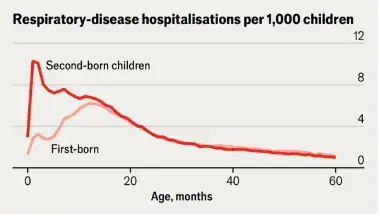
- firstborns often get fewer infections: no older siblings bringing home viruses from school or daycare.
- Later births have lower vitamin D levels if there was less than 2 years between births - the mother's vitamin D levels have not been restored. She may also not be outdoors as much when caring for her first child
10 fewer health problems in firstborn - often respiratory or viral
Nearly all the firmly established "firstborn advantage" conditions are infectious diseases of early childhood, driven by the absence of an older-sibling vector. Ranked roughly by effect size and evidence quality:
RSV / bronchiolitis / viral pneumonia in infancy — the largest and most replicated effect. Having ≥1 older sibling typically doubles RSV hospitalization risk in the first year.
Acute otitis media — firstborns have fewer episodes and later first episode. Sibling number is among the strongest modifiable-ish risk factors in the literature.
Upper respiratory infections (rhinovirus, coronaviruses, parainfluenza) — fewer colds per year until firstborns themselves enter group care, at which point they catch up.
Rotavirus and other viral gastroenteritis in infancy — sibling fecal-oral and fomite transmission is the dominant exposure pathway pre-daycare.
Pertussis in young infants — older siblings are the leading identified source in contact-tracing studies of infant pertussis, including severe and fatal cases.
Early varicella (pre-vaccine era data) — firstborns acquired chickenpox later and less often before age 2; secondary household attack rates from sibling index cases exceeded 80%.
Influenza in the first 1–2 years — schoolchildren are the classic community amplifier; household transmission to infant siblings is well documented.
Hand-foot-mouth disease and other enteroviral illnesses — childcare-age siblings are the main introduction route into the home.
Invasive pneumococcal and meningococcal disease in infancy — mediated by higher nasopharyngeal carriage rates in older siblings; modest but consistent effect.
All-cause hospitalization for infection in the first year of life — composite outcome in several large registry studies (Scandinavian cohorts especially) showing clear dose-response with number of older siblings.
A few honorable mentions with weaker or more mixed evidence: croup, tuberculosis (historical, driven by crowding rather than birth order per se), and H. influenzae type b disease pre-vaccine.
The vitamin D overlay is most relevant for categories 1, 3, 7, and 10, where maternal and infant 25(OH)D status independently modulate risk — so the sibling-exposure protection and vitamin D sufficiency are somewhat additive rather than competing explanations.
Many studies have found that firstborns have 1 or 2 point higher IQs
Related in Vitamin D Life
- Middle ear infection (Otitis Media) and Vitamin D – many studies
- Common cold (Acute Rhinosinusitis) virtually non-existant when Vitamin D is above 50 ng
- Respiratory viral infection (RSV) and low vitamin D - many studies
- Bronchiectasis strongly associated with low vitamin D