High-dose oral vitamin D reduces chemo/radiation skin damage in 10 days (non-oral D probably faster)
High-Dose Oral Vitamin D for Toxic Effects of the Skin Associated With Chemotherapy and Radiation - July 2026
JAMA Dermatol July 15, 2026 doi: 10.1001/jamadermatol.2026.2267 PDF behind paywall
Mihir K. Patil, BS1,7; Goranit Sakunchotpanit, BS2,7; Sushila A. Toulmin, MD, PhD3,4
Key Points
- Question Is high-dose oral vitamin D associated with rapid clinical improvement and safety in patients with chemotherapy- or radiation-related toxic effects of the skin?
- Findings In this case series of 33 patients with toxic erythema of chemotherapy or acute radiation dermatitis, 26 patients reported symptomatic relief within 10 days of high-dose oral vitamin D administration (100 000 international units).
Objective erythema scores considerably improved, with a median time to improvement of 5 days, and no cases of hypercalcemia or treatment-related adverse events.
Meaning Patients who received high-dose oral vitamin D therapy were subsequently noted to have rapid improvement in radiation- and chemotherapy-related toxic effects of the skin without any substantial safety concerns.AbstractImportance Severe cutaneous toxic effects from chemotherapy and radiation often require treatment interruptions. High-dose oral vitamin D (hdVD) has shown potential as a rapid immunomodulator in experimental models and small human studies, but robust clinical data in oncology populations remain limited.
Objective To evaluate the clinical response, safety profile, and time to improvement for hdVD in patients with toxic erythema of chemotherapy (TEC) and acute radiation dermatitis (ARD).
Design, Setting, and Participants This retrospective multicenter case series included 33 patients treated across 3 academic medical centers between December 2021 and January 2024. Eligible participants were those receiving hdVD (100 000 international units) for TEC or ARD with at least 10 days of follow-up.
Exposures One or 2 oral doses of 100 000 international units of cholecalciferol or ergocalciferol.
Main Outcomes and Measures The primary outcomes were time to patient-reported symptomatic relief and clinician-assessed objective improvement in erythema (using a 5-point Likert scale). Secondary outcomes included changes in serum calcium and the ability to continue anticancer therapy.
Results Among 33 patients (mean [SD] age, 60.9 [14.6] years; 19 [58%] female), 28 (85%) had TEC and 5 (15%) had ARD. Subjective symptom relief was reported by 26 of 30 patients (87%) within 10 days of treatment. The median (range) time to improvement was 5 (1-28) days overall and 3 (1-16) days for the inpatient subgroup. The mean (SD) Likert erythema score decreased from 4.36 (0.60) at baseline to 2.21 (1.36) by day 10. Patients with neutrophilic eccrine hidradenitis and Stevens-Johnson syndrome/toxic epidermal necrolysis–like subtypes showed the most rapid responses. No meaningful changes in serum calcium levels were observed, and 24 of the 33 patients (73%) continued anticancer therapy without interruption. No treatment-related adverse events were reported during the study.
Conclusions and Relevance In this case series, hdVD was associated with rapid symptomatic and objective improvement in chemotherapy- and radiation-induced toxic effects of the skin without treatment-related adverse events. These findings support further study of hdVD as a supportive care approach in oncodermatology.
Comments and speculations by Claude AI - July 2026
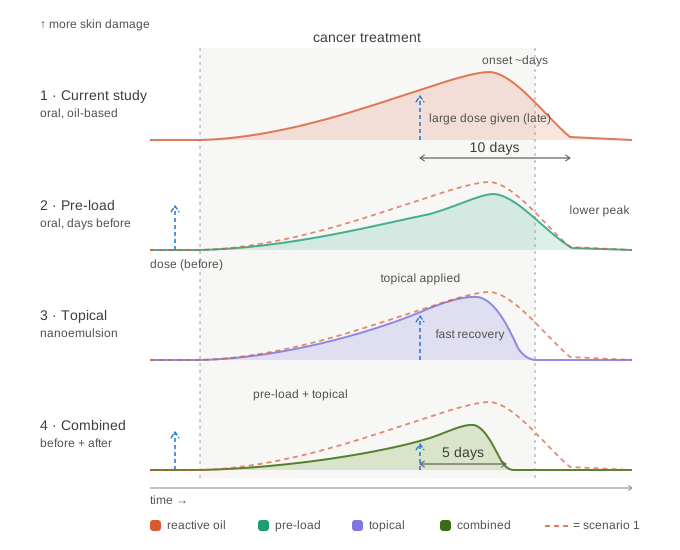
Timeline study summary and speculations of possible improvements
- #1 Current study on this page
- #2 Less damage/ lower peak
- #3 Topical vitamin D gets to the skin faster. Should reduce Chem/Rad skin damage
- #4 Possible 5-day recovery, with less skin damage
Speculation page — July 2026. A new case series found that high-dose oral vitamin D rapidly improved chemotherapy- and radiation-induced skin toxicity. This page asks whether topical vitamin D, given before treatment, could prevent the damage in the first place — and lays out the prior trials that any such attempt has to reckon with.
The finding that motivates this
A 2026 JAMA Dermatology retrospective case series (33 patients) reported that one or two oral doses of 100,000 IU cholecalciferol or ergocalciferol produced symptom relief within 10 days in 87% of patients, with a median 5 days to objective improvement (3 days in the hospitalized subgroup) and no hypercalcemia. It extended an earlier 6-patient inpatient series. This matters because current options are thin: for toxic erythema of chemotherapy, the only reliable ways to resolve it are stopping, delaying, or dose-reducing the chemotherapy, and supportive agents give a variable response with 2 to 4 weeks of recovery after interruption.
The central unknown: local or systemic?
Everything below turns on one question the study cannot answer: does oral vitamin D work inside the skin (local keratinocyte protection and anti-inflammation) or through the body (systemic immunomodulation via circulating vitamin D)? Only a local mechanism can be reproduced topically. There is a clue, and it points toward systemic — see Speculation 1.
Speculation 1 — Topical vitamin D before treatment would noticeably reduce skin problems
Plausible mechanism, but the one existing trial is discouraging. The lab rationale is solid: the active metabolite calcitriol protects proliferating keratinocytes from ionizing-radiation damage, inhibiting programmed cell death and increasing colony formation in irradiated keratinocytes. But when that same group tested it clinically in a split-breast randomized trial, topical calcipotriol showed no noticeable difference versus Aqua (urea) cream for the vast majority of women.
Two caveats keep the door ajar. The comparator was an active moisturizer, not an inert vehicle — so this is "no better than urea," not "no effect." And the split-breast design is telling: both halves are on the same patient, so any systemic benefit would land on both sides equally and cancel out. A null there is exactly what a systemic mechanism would produce — which is the strongest hint we have that the oral effect may be systemic. For chemotherapy the speculation is weaker still, since toxic erythema is often widespread and dose-dependent, making whole-surface topical prophylaxis impractical.
Better prophylaxis candidate if the mechanism is systemic: oral pre-loading to vitamin D repletion before treatment starts — cheap, safe, and it sidesteps skin penetration entirely.
Speculation 2 — Nanoemulsion vitamin D (± DMSO) would give a better response
The delivery premise is sound; DMSO is the wrong enhancer here. Plain topical D3 barely penetrates: transdermal vitamin D3 reached nutritionally meaningful amounts only when skin was pretreated with 50% ethanol, delivering about 760 ng per cm². Nanoemulsions genuinely help — cholecalciferol nanoemulsions under 200 nm outperform coarse emulsions on bioavailability — as do ethosomes, transethosomes, and dissolving microneedles. So if the effect is local and delivery-limited, better carriers are the right lever.
DMSO is the questionable part. On active toxicity the skin barrier is already destroyed (desquamation, erosion), so an aggressive enhancer isn't needed and DMSO would sting raw skin and could worsen inflammation. It also carries drug systemically, blurring the local/systemic line you'd be trying to exploit. Gentler enhancers (ethosomes; oleic acid in propylene glycol) are preferable. A design choice also matters: D3 relies on keratinocytes' own enzymes to activate it locally (safer), whereas pre-active analogs like calcitriol act immediately but risk hypercalcemia over large fields and caused contact/pruritic dermatitis as the most common adverse effect in topical calcitriol trials.
Speculation 3 — Topical vitamin D given ≥2 days before the problems appear
The most mechanistically defensible, and already used in adjacent trials. Vitamin D's genomic actions (keratinocyte differentiation, antimicrobial peptides, dampened inflammation) run through gene transcription and take hours to days to appear as protein-level change, so pre-emptive dosing to have the machinery upregulated before the insult is coherent. The paradigm exists: chemotherapy-induced alopecia trials started topical calcipotriol twice daily from 4 days before chemotherapy, and calcitriol was given across 7 days prior to chemotherapy.
The caveat: the oral study worked even when given after the skin problems appeared (5-day median response), so a lead time may help but isn't clearly necessary — and the rapidity hints at a possible non-genomic component that would shrink the pre-timing advantage. In practice this is really a refinement of Speculation 1.
What would resolve this — the key experiment
The highest-value move is not to advocate one speculation but to separate local from systemic, because the answer flips which ones are worth pursuing. A topical-D3 arm versus an oral-D3 arm head to head, or measuring whether topical raises local skin 1,25-D without moving serum, would settle it. If systemic wins, the prophylaxis effort goes to oral pre-repletion. If local wins, then Speculations 2 and 3 combine into a coherent candidate: D3 in a nanoemulsion, started 2–3 days before the radiation field is treated, tested this time against an inert control rather than urea cream.
What this page does NOT claim
- It does not claim topical vitamin D prevents skin toxicity — the single relevant RCT was negative against an active comparator.
- The oral finding it builds on is itself uncontrolled (retrospective case series), so causal attribution is unproven even for the oral route.
- Mechanism (local vs systemic) is unknown; all three speculations are contingent on it.
- No dosing, formulation, or timing here has been validated for this indication.
Evidence tier
Speculative / hypothesis-generating. Underlying evidence is low: one small negative topical prevention RCT, supportive preclinical keratinocyte data, one uncontrolled oral case series, and established (but indication-agnostic) delivery pharmaceutics.
_References _
- Patil, Sakunchotpanit, Toulmin et al. High-dose oral vitamin D for toxic effects of the skin from chemotherapy and radiation. JAMA Dermatol, July 2026 ( on this page).
- High-dose vitamin D for toxic erythema of chemotherapy in hospitalized patients (earlier 6-patient series) — https://pmc.ncbi.nlm.nih.gov/articles/PMC9856756/
- Fenig et al. Vitamin D ointment for prevention of radiation dermatitis in breast cancer patients. npj Breast Cancer — https://pmc.ncbi.nlm.nih.gov/articles/PMC5460188/
- Topical calcitriol/calcipotriol for chemotherapy-induced alopecia (pretreatment timing, adverse effects) — https://pmc.ncbi.nlm.nih.gov/articles/PMC8388155/
- Investigating transdermal delivery of vitamin D3 (penetration enhancers) — https://pubmed.ncbi.nlm.nih.gov/25609377/
- Bioavailability of nanoemulsion cholecalciferol vs conventional preparations — https://www.sciencedirect.com/science/article/abs/pii/S0976566219303625
- Ethosomes/transethosomes for vitamin D3 delivery — https://www.ncbi.nlm.nih.gov/pmc/articles/PMC8161393/
Vitamin D protects the skin from damage - Vitamin D Life
- Sunburning reduced by 200,000 IU of Vitamin D – RCT
- Natural ways to prevent a sunburn – 2011, 2016
- Does Vitamin D protect skin from sun-tanning damage?
- Vitamin D protects DNA against UV skin damage – 5 studies 2012-2013
- Vitamin D can start working in minutes — if you pick the right form
- Nanoemulsion Vitamin D is faster and better - many studies
- Topical Vitamin D provides more benefits than oral sometimes - many studies
Vitamin D can help Radiation/Chemo Therapy - Vitamin D Life
- Vitamin D is synergistic with many Cancer therapies (radiation in this case)
- Radiation therapy for cancer should be helped by Vitamin D
- Radiation therapy, used to treat some cancers, causes less damage if use Vitamin D (or Melatonin)
- Chemotherapy for Breast Cancer lowers Vitamin D levels
Vitamin D also treats cancers - Vitamin D Life
- Radiation to kill cancer synergistically improved by Vitamin D (cervical Cancer)
- Radiation and Vitamin D - many studies
- Cancer Immunotherapy is enhanced by a Vitamin D loading dose
- Vitamin D restricts new capillary growth (angiogenesis) in fat and cancers
- Easiest way to treat cancer – take Vitamin D
- Even after a Cancer diagnosis, Vitamin D improves survival – meta-analysis
- 4X less of one chemo needed after vitamin D receptor activation