
Atrazine (a weedkiller) may reduce Vitamin D levels
The plausible bridge: atrazine → PXR → accelerated vitamin D catabolism
The strongest connection runs through the pregnane X receptor. Atrazine exposure activates PXR in mice, disrupting CYP450 homeostasis (shown in the context of atrazine-induced nephrotoxicity, which lycopene partially reversed by modulating that PXR/CYP450 response). PXR is the master xenobiotic sensor that governs much of the liver and intestine's drug-metabolizing machinery.
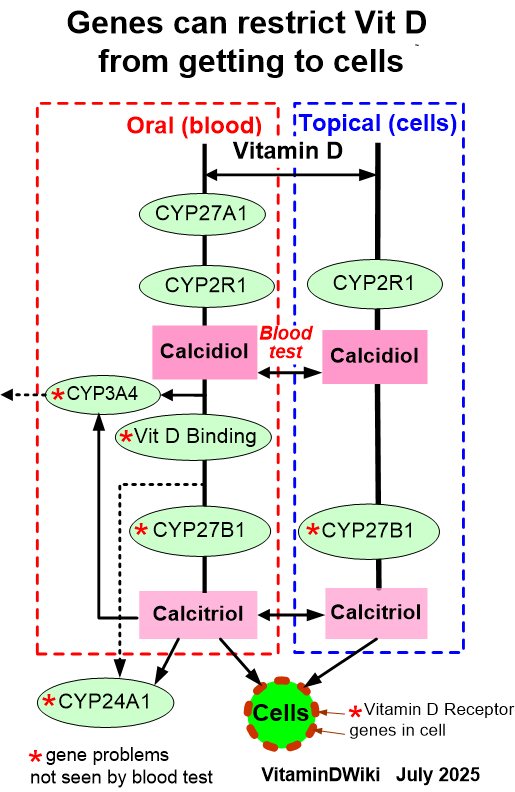
The reason that matters for vitamin D: PXR activation is the established mechanism behind drug-induced vitamin D deficiency and osteomalacia. Drug-induced vitamin D deficiency and osteomalacia is a well-recognized complication of many medications that induce CYP3A4, which acts as an alternative degradative pathway to CYP24A1. The rifampicin case is the cleanest illustration — it's a prototypical PXR agonist, and pre-treating intestinal cells with rifampin produced a 48% increase in the elimination of 1α,25(OH)₂D₃ and a 35% reduction in the downstream calcium transporter TRPV6 response. So the logic chain is: atrazine activates PXR (demonstrated) → PXR induces CYP3A4 (demonstrated) → CYP3A4 accelerates vitamin D breakdown (demonstrated). What's missing is anyone connecting the first and last links for atrazine specifically.
An important complication worth flagging honestly
The CYP24A1 side of the PXR story is genuinely contested, so don't overstate it. Early work (Pascussi 2005) suggested PXR induces CYP24A1, but that's been challenged. One group found the induction of CYP24A1 by rifampicin is extremely weak compared with vitamin D3 induction, and rifampicin actually represses CYP24A1 in the presence of vitamin D3 — by locking the corepressor SMRT onto the CYP24A1 promoter. The LS180 intestinal model likewise found rifampin raised CYP3A4 but had no effect on CYP24A1. So the operative pathway is almost certainly CYP3A4-mediated catabolism, not CYP24A1 induction — a distinction that matters if you write this up.
Adjacent findings that are suggestive but not the same thing
Atrazine's best-documented endocrine mechanism is separate: it's a potent endocrine disruptor that increases aromatase (CYP19) expression via a steroidogenic-factor-1-dependent mechanism, acting as an artificial ligand for SF-1, downstream of phosphodiesterase-4 inhibition and elevated cAMP. That's an estrogen/steroidogenesis story, not a vitamin D one — but it establishes that atrazine readily perturbs nuclear-receptor and CYP biology.
What this does NOT show
- No epidemiology. The one human pesticide-and-vitamin-D study I found tested organochlorines (a different chemical class — atrazine is a chlorotriazine), and even there no correlations were found between individual or total organochlorine pesticides and 25(OH)D₃ in a small cohort of 58 women. That's a null result for a different compound, not evidence about atrazine.
- No demonstration that environmentally realistic atrazine doses (drinking-water exposure) activate human PXR enough to move serum 25(OH)D. The PXR activation was shown in mice, and dose-response in humans is unknown.
- No direct measurement of 25(OH)D in atrazine-exposed farmworkers, which would be the obvious first test.
The gap, in your (Vitamin D Life) "profitable ignorance" frame
This is a textbook underinvestigated link: a mechanistically plausible, unpatentable, non-commercial hypothesis (a widely-used herbicide potentially lowering vitamin D status via a well-characterized xenobiotic pathway) that nobody has an incentive to run. The testable prediction is concrete — atrazine-exposed populations (agricultural regions with high water contamination, seasonal applicators) should show measurably lower 25(OH)D or faster 25(OH)D clearance than matched controls, and the effect should track CYP3A4 activity rather than CYP24A1.
Atrazine is banned in roughly 60+ countries
though it remains legal and heavily used in several major agricultural nations. Here's the picture:
Banned in Europe since 2004
The most significant bloc is the European Union, which phased it out with a ban that took effect in 2004 (the decision was announced in October 2003). The EU's ban was based on a strict maximum acceptable pollutant level of 0.1 μg/L — a threshold routinely exceeded in U.S. groundwater. Notably, Germany and Italy banned atrazine even earlier, in 1991, due to its persistence in the environment, toxicity to wildlife, and human health links.
Beyond the EU, the bans extend across much of the world. The roughly 60 countries include all 27 EU members, most Middle Eastern countries, and many African countries. The Gulf Cooperation Council states have also banned it. One caveat worth noting: in many lower- and middle-income countries where atrazine is officially banned, the chemical is often smuggled in illegally.
Notably still used in the US, 2nd behind Glyphosate
The United States is the notable outlier among high-income countries. Canada, Australia, Brazil, and China also continue to use atrazine to increase crop yields. In the U.S. it's the second-most widely used herbicide after glyphosate.
Recent regulatory shifts
Two developments post-date some of the older framing on this topic. First, the WHO's International Agency for Research on Cancer classified atrazine as "probably carcinogenic to humans" in a determination published in the January 2026 issue of The Lancet Oncology — its first assessment of the compound in nearly three decades (the prior 1998 ruling had deemed it not classifiable). Second, moving in the opposite direction, in October 2025 the U.S. EPA kept atrazine legal and weakened existing safeguards, and on May 18, 2026, the U.S. Fish and Wildlife Service finalized a review concluding atrazine does not pose an extinction risk to endangered species — contradicting years of the agency's own research.
CYP . . . chart from Vitamin D Life
Related in Vitamin D Life
- Pesticides, herbicides, insecticides, Glyphosate, etc. deactivate Vitamin D genes
- 20 things in US food which are banned elsewhere: Pesticides, Roundup, PFAS, BHA, Growth hormone, antibiotics, etc.
Dr. Malone on Atrazine, Roundup, etc July 2026
Short URL for this page = https://is.gd/atrazine