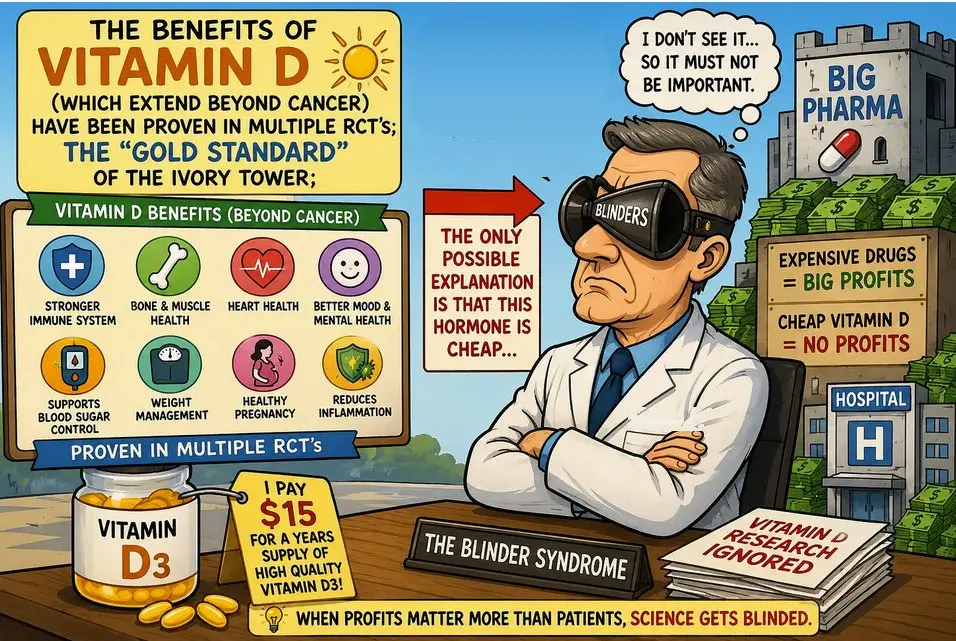
$5 a year of Vitamin D could prevent 2.5 million US diabetes cases while saving money
The cost-effectiveness of vitamin D supplementation for the prevention of type 2 diabetes in the United States: a microsimulation modelling study
The Lancet Regional Health – Americas,(Sept. 2026), https://doi.org/10.1016/j.lana.2026.101543
Jonathan Briody, Anastassios G. Pittas, Ping Zhang, Yixue Shao, Edward Gregg
Summary by Claude - July, 2026
For adults with prediabetes, daily vitamin D isn't just worth the money — this analysis finds it actually saves money while preventing diabetes.
This is a microsimulation modelling study, not a new clinical trial. The team ran the validated CDC/RTI diabetes model on a simulated cohort of 10,000 U.S. adults with prediabetes (parameterized from NHANES 2013–2018, n=4,176), applying a 15% reduction in diabetes risk drawn from a 2023 individual-participant meta-analysis of three vitamin D RCTs (D2d, DPVD, Tromsø). The modelled dose was 4,000 IU/day of D3 (cholecalciferol), given empirically without blood testing, at ~$60/year and 85% adherence, in people with BMI ≥25.
Over a lifetime horizon, supplementation lowered per-person medical costs by ~$3,200, added 0.12 QALYs and 0.27 life-years, and cut lifetime diabetes incidence by 8% (net monetary benefit $15,483 at a $100,000/QALY threshold). It stayed cost-saving in every scenario tested — including pessimistic ones where efficacy faded after 5 years or supplements were given only 3 years. Benefits were largest with higher BMI, higher fasting glucose, family history, or younger age. Scaled to the ~98 million U.S. adults with prediabetes, the authors estimate ~2.5 million fewer lifetime diabetes cases.
What this does NOT show: It's a projection, not measured outcomes. It assumes the meta-analysis's 15% risk reduction holds for decades, whereas the source trials ran a median of ~3 years and each trial individually missed statistical significance. It assumes zero adverse events and no benefit once diabetes develops. Senior author Pittas discloses grant/travel support from Abiogen, a vitamin D manufacturer.
This simulation assumed a 15% reduction in diabetes-related expenses
Far more savings if
1) take the same average amount of vitamin D once every 2 weeks
2) Use a gut-friendly form of vitamin D
Many other studies found vitamin D would be cost-effective - if just prevent a single disease
- Diabetes prevented by 50,000 IU vitamin D monthly (Iran)
- Vitamin D for all senior Germans would cost-effectively prevent 30,000 cancer deaths annually
- Vitamin D has been found to be cost-effective by many studies
- Depression cost-effectively reduced by 50,000 IU of Vitamin D monthly (Iranian teens)
- Giving free vitamin D to every Iranian would pay for itself by just reducing CVD
- Perhaps 4,000 dollars annual less health care costs per person if supplemented with 5 dollars of Vitamin D
- Vitamin D supplementation of all pregnant women (in UK) would be cost effective – just considering preeclampsia
- Mechanisms by which Vitamin D prevents and treats a score of diseases
Vitamin D prevents diabetes
- Take Vitamin D to prevent prediabetes from progressing into diabetes – American Diabetic Association – 2024
- Prediabetes reduced by weekly 60,000 IU of Vitamin D – RCT
- Prediabetes both prevented and treated by monthly Vitamin D, etc.
Unfortunately, doctors are paid to treat, not prevent, diseases